
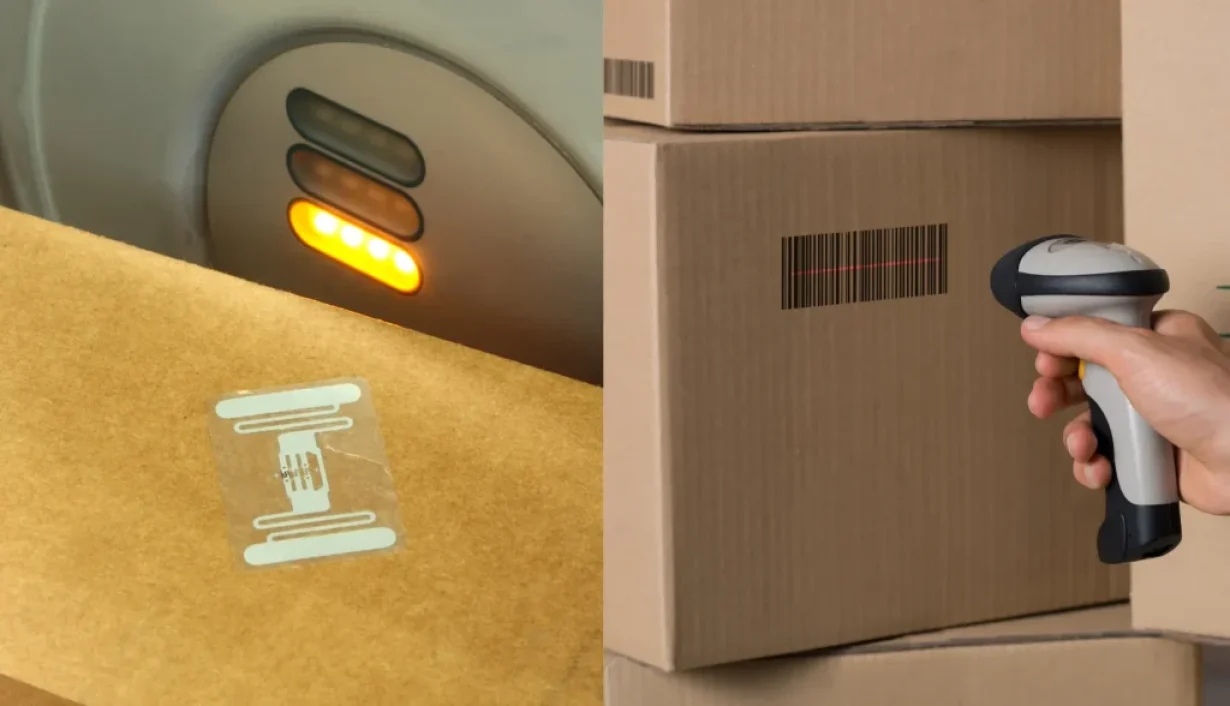
In at present’s enterprise administration world, holding observe of stock is essential for reinforcing provide chain effectivity. RFID and barcodes are the highest two applied sciences getting used. Each are important for automating stock and enhancing administration effectivity. That stated, there are main variations between RFID and barcodes by way of how they work, value, and the place they are often utilized. Companies want to select the correct tech based mostly on their particular wants.
What are RFID and Barcodes?
RFID
RFID (Radio Frequency Identification) is a wi-fi communication expertise that makes use of radio waves to transmit knowledge. It consists of RFID tags (that are made from a chip and an antenna) and RFID readers. The tag sends its saved data to the reader through radio alerts, permitting for automated merchandise identification and knowledge trade.
Lively RFID tags: These include a battery and might actively transmit alerts, making them best for long-distance identification.
Passive RFID tags: These don’t have a battery and rely upon the radio alerts from the reader for energy, in order that they work greatest for short-range monitoring.
Semi-passive RFID tags: These have a battery that prompts upon receiving alerts from the reader, permitting them to establish gadgets from a distance.
The principle benefit of RFID expertise is its potential to rapidly learn info from afar with no need bodily contact, which is why it’s so common in stock administration.
Barcodes
A barcode is a graphical method to encode knowledge, represented by a mixture of black and white stripes. The commonest varieties are one-dimensional barcodes and QR codes. Scanners are wanted to learn barcodes, utilizing mild reflection to decode the information.
One-dimensional barcodes: Composed of parallel black and white stripes, these are used for on a regular basis gadgets like groceries and books.
QR codes (two-dimensional barcodes) : These can maintain extra knowledge and are extensively utilized in functions like cell funds and superior logistics.
Barcode expertise is without doubt one of the earliest strategies for automating knowledge seize. Whereas it’s established and cost-effective, barcode expertise doesn’t match RFID in knowledge storage capability and studying effectivity.
Key Variations Between RFID and Barcodes
Technical Rules
RFID: RFID makes use of radio frequency electromagnetic waves for communication. Every RFID tag has a chip that shops knowledge, and when the tag enters the vary of an RFID reader, it transmits that knowledge through radio waves. A standout characteristic of RFID is that it doesn’t require direct contact and even alignment with a scanner; it could actually learn distances from just a few centimeters to a number of meters, with some techniques going even farther.
Barcodes: Barcodes, alternatively, are optical tech that require a scanner to learn their patterns by means of mild reflection. Sometimes, barcodes want a direct line of sight with the scanner. Environmental components, resembling grime or put on, can disrupt the scanning course of and decelerate barcode studying.
Information Storage and Studying Functionality
RFID: RFID tags can retailer way more knowledge than barcodes can. Normal barcodes can solely maintain fundamental identification numbers, whereas RFID tags can include a wealth of extra info like manufacture dates, batch numbers, and expiration particulars. Some superior RFID tags even assist dynamic updates, permitting for read-write operations, which is essential for industries that repeatedly replace their stock data.
Barcodes: Barcodes can solely retailer a restricted variety of digits or letters (normally as much as 13), they usually can’t maintain a lot extra info. They will solely learn knowledge in a single course, that means you may’t write new info again to the barcode.
Effectivity and Accuracy in Studying
RFID: RFID helps batch studying, so it could actually learn a number of tags without delay. This drastically boosts effectivity when coping with massive inventories. For instance, in a warehouse, an RFID reader can scan many gadgets on the similar time with no need to go one after the other, which saves time and cuts down on human error. Plus, RFID tends to be extra correct because it doesn’t depend on direct line of sight, avoiding points like studying failures that may occur with broken or obscured barcodes.
Barcodes: Barcode studying is much less environment friendly as a result of it could actually solely scan one tag at a time, and requires a transparent line of sight to operate correctly. Barcodes are much less correct and might expertise scan failures on account of components like mud, smudges, or put on.
Price and Implementation
RFID: Preliminary funding for RFID techniques is comparatively excessive. Along with the tags, RFID readers and the required {hardware} (like sensors and community connections) require a major quantity of upfront funding. Plus, RFID tags could be pricier, particularly long-lasting high-performance ones. However in the long term, RFID can drastically increase the automation of stock administration, decreasing labor prices and errors.
Barcodes: Barcode expertise is less expensive, with label printing and scanning tools being comparatively inexpensive, making it common in numerous industries. Implementing barcode expertise doesn’t want advanced infrastructure, making it a great match for small companies on a finances or for less complicated stock administration wants.
Finest Uses for RFID and Barcodes
Finest Uses for RFID
Massive-Scale Warehouse Administration and Provide Chain Monitoring
RFID actually excels in massive warehouses and logistics facilities. It automates the monitoring of products throughout storage, dealing with, delivery, and supply, considerably enhancing effectivity and slicing down on guide work and errors. Large corporations like Amazon and Walmart extensively use RFID expertise of their warehouse techniques to streamline stock administration.
Monitoring and Theft Prevention of Excessive-Worth Objects
On the subject of managing high-value gadgets like jewellery, luxurious items, and electronics, RFID is a game-changer for stopping theft and loss. RFID tags enable scanning from a distance, so even when somebody strikes an merchandise from its authentic spot, the RFID system tracks it in real-time and sends alerts.
Medical Asset Administration
In healthcare, RFID helps observe drugs, tools, and medical data. Hospitals use RFID to observe the placement and utilization of medical units in real-time, making certain their reliability and security whereas minimizing misuse and loss.
Finest Uses for Barcodes
Retail and Supermarkets
Retailers extensively use barcodes for pricing gadgets and managing stock. They permit for fast knowledge retrieval at checkout and environment friendly monitoring and restocking features for stock administration. Most retailers, together with Walmart and Carrefour, rely upon barcode expertise to regulate the stream of merchandise.
Small Companies and Funds-Pleasant Situations
For small companies or startups on a finances, barcodes are a sensible and inexpensive resolution. They will rapidly arrange stock administration techniques utilizing cheap barcode printers and scanners, requiring little upfront funding.
Easy Stock Administration
Barcodes work greatest for industries with smaller inventories and easy administration wants. They’re appropriate for smaller warehouses or outlets the place excessive automation ranges and real-time monitoring aren’t important.
Conclusion
RFID and barcodes each have their distinctive benefits, so companies ought to resolve based mostly on their particular wants. RFID supplies greater effectivity, accuracy, and automation, making it well-suited for managing large-scale and high-value items. In distinction, small companies or easy stock administration profit from barcodes on account of their affordability and ease of use. Regardless of which expertise you select, the essential half is optimizing your stock administration system based on your precise operational wants to spice up your organization’s effectivity and competitiveness.
FAQs
What are the variations in accuracy and reliability between barcodes and RFID in stock administration?
RFID normally has higher accuracy and reliability in stock administration than barcodes. Since RFID can scan robotically and doesn’t want a direct line of sight, it could actually establish tags even when they’re partially blocked or broken, due to its distinctive radio frequency alerts. Barcodes, alternatively, depend on seen mild to scan and might simply get tousled by obstructions, grime, or wrinkles, which might result in failed scans or errors. So usually, RFID beats barcodes by way of precision and reliability, particularly in settings the place excessive accuracy and effectivity are essential.
Can RFID be used to handle dynamic stock? As an example, gadgets which can be often transferring round in a warehouse?
Sure, RFID is ideal for managing dynamic stock, particularly merchandise that transfer round quite a bit inside a warehouse. One of many fundamental advantages of RFID is its potential to allow real-time automated monitoring and assist batch studying of tags. Because of this even when gadgets often relocate within the warehouse, the RFID system can rapidly replace the stock standing with out manually scanning every merchandise.
How can companies reduce sign interference that influence knowledge accuracy when implementing RFID?
Supplies like metallic and liquids replicate or soak up the alerts, inflicting sign interference for RFID. To cut back interference when establishing an RFID system, companies can take steps resembling selecting the correct frequency (low, excessive, or ultra-high), optimizing antenna placement, avoiding sticking RFID tags instantly onto metallic objects, or choosing anti-interference tags. Plus, maintaining with common upkeep and checks on RFID tools is a brilliant method to hold the system operating easily.
Really useful merchandise

Impinj Monza® R6-P ABS and Nylon RFID Cable Tie Tag

Warmth Resistant NXP UCODE®8 PPS RFID On-metal Tag | 26×26mm
Warmth Resistant Alien Higgs® 3 PPS RFID On-Steel Tag | 26×26mm

Chemical Resistant NXP UCODE® 8 PEEK RFID On-Steel Tag | 41×29 mm


RFID Antenna UHF
15-Meter Cable for UHF RFID Fixed Reader
UHF Tag
4″x2″ 860-960MHz UHF RFID Label RFID M4D
UHF Tag
4″x4″UHF RFID Label Alien H3 | ISO18000-6C
RFID Antenna UHF
5-Meter Cable for UHF RFID Fixed Reader
HF Card
ABS RFID KEY-FOB Tag RFID Classic 1K
HF Card
ABS RFID KEY-FOB Tag RFID Classic 4K
HF Card
ABS RFID KEY-FOB Tag RFID Ultralight C
HF Tag
ABS RFID KEY-FOB Tag RFID Ultralight EV1
LF Card
ABS RFID KEY-FOB Tag ATA5577
LF Card
ABS RFID KEY-FOB Tag EM4200
HF Card
ABS RFID KEY-FOB Tag EM4305
HF Card
ABS RFID KEY-FOB Tag RFID TAG 213